
Reviewed · TOURS IN DUBAI
Dubai: Cultural Lunch at The Sheikh Mohammed Center
Dubai’s best cultural lesson may happen over a plate of food. At the Sheikh Mohammed Center for Cultural Understanding, you sit on floor cushions in a traditional wind tower house, share Emirati dishes, and ask direct questions about religion, customs, greetings, family life, and local values. I like the relaxed format and the chance to talk rather than simply watch a staged performance. I also like the setting in Al Fahidi, where the building itself explains how older Dubai dealt with heat.
The hosts, including guides such as Khaled, Nasser, Ruqaya, and Moeen Murad on different occasions, have been praised for warmth, humor, and clear answers. The main drawback is finding House 26, especially when construction affects paths in Al Fahidi. Also, the food selection can vary, and one meal was described as more Indian than Arabic.
Key points to know before you book
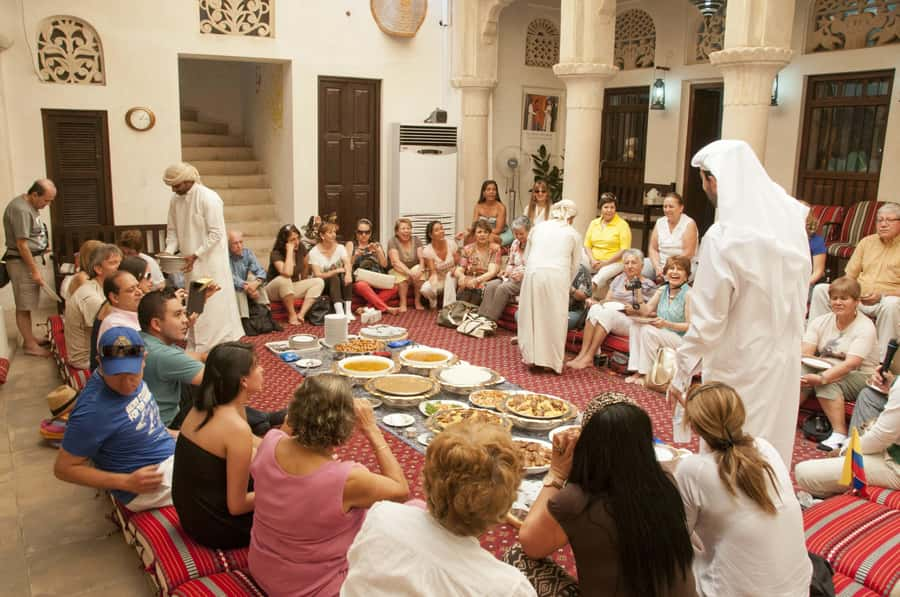
- A meal with an open-question format: Your host invites questions about Islam, Emirati customs, clothing, family life, and local sensitivities.
- A traditional wind tower house: The lunch takes place in a historic Al Fahidi building, not a modern restaurant.
- Arabic coffee, tea, and dates: These provide a simple introduction to local hospitality before the meal.
- Only 1.5 hours long: It fits neatly into a morning or afternoon of exploring old Dubai.
- English-language cultural guidance: The host or hostess presents the program in English.
- Good value for a first look at Emirati life: At $42 per person, the price covers the meal, drinks, setting, and cultural conversation.
Why this lunch gives Dubai more context
Dubai is easy to experience as a skyline, shopping, and hotel destination. You can admire the Burj Khalifa and still leave without much sense of the people, beliefs, and customs that shape life in the United Arab Emirates. This lunch addresses that gap in a practical way.
The Sheikh Mohammed Center for Cultural Understanding was created to improve communication between local people and visitors. Its approach is simple: sit together, eat together, and make room for questions that might otherwise go unasked. That matters in a place where religion, dress, hospitality, family, and public behavior can differ from what you know at home.
I like that the conversation is part of the meal, not an extra lecture tacked onto it. You are encouraged to ask about the impact of Islam on local values and sensitivities, along with everyday customs and traditions. The tone is informal, so this suits you if you learn best through conversation rather than a museum label.
The experience is also useful early in a Dubai trip. A lunch here can help you read the city with better context afterward. You may understand why certain greetings matter, why hospitality is taken seriously, or why some behavior that seems ordinary elsewhere calls for more care in the UAE.
Other trips people book in Dubai:
- Dubai: Burj Khalifa Levels 124 & 125 Entry Ticket + Options
★ 4.3 · 90,891 reviews - Dubai: Desert Safari, Quad Bike, Camel Ride & Al Khayma Camp
★ 4.9 · 68,962 reviews - Dubai: Desert Safari, Quad Bike, Camel Ride and Sandboarding
★ 4.9 · 43,505 reviews
Entering House 26 in Al Fahidi Historic District
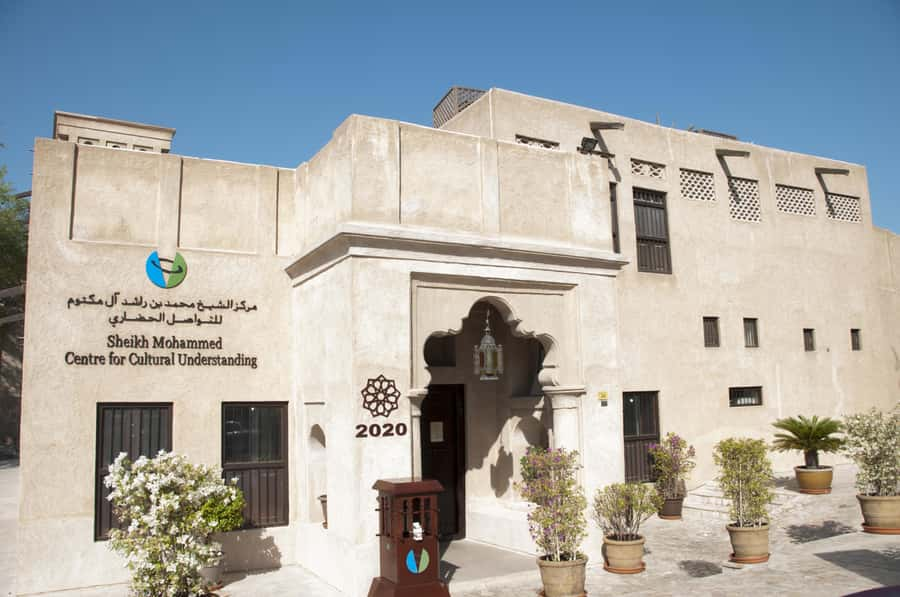
The meeting point is House 26 on Al Musallah Road, beside the Ruler’s Court, in the Al Fahidi Historic District. The center occupies a traditional wind tower house in the old Al Bastakiya trading village.
The building is part of the lesson. Before air-conditioning, wind towers helped draw air through homes and offered relief from Dubai’s heat. The house also gives you a sense of the older settlement pattern, with a courtyard and rooms arranged around it rather than the glass towers now associated with Dubai.
The center’s setting feels more fitting than a hotel dining room would. You are not just told about traditional architecture. You are sitting inside it. Floor cushions in the courtyard keep the mood informal, though anyone who finds low seating difficult may want to take the accessibility information seriously and check arrangements in advance.
Finding the entrance can take patience. House numbers and paths in Al Fahidi are not always obvious, and construction has made some approaches less clear. One useful tip is to allow extra time and look carefully for House 26 rather than relying only on a general welcome sign. The area has had confusing doors and blocked pathways, so arriving at the wrong entrance is possible.
The center is listed as wheelchair accessible. Still, the historic district and traditional building may make the route to the entrance less straightforward than a modern venue. If accessibility affects your plans, confirm the current path and seating details before you go.
Arabic coffee, dates, and the first conversation
The meal begins with traditional hospitality: Arabic coffee, tea, and dates. This is more than a quick drink before lunch. Your host can use these familiar local offerings to explain how food and drink help welcome people in Emirati culture.
Arabic coffee is typically served in small amounts and may be poured repeatedly. The experience information does not specify the exact coffee style or serving routine for every session, so expect the format to vary. What is consistent is the chance to taste local drinks and begin the conversation in a social setting.
Dates are also included, giving you a straightforward introduction to a food closely associated with the region. You can ask about customs around serving, accepting, or sharing food without needing to wait for a formal question period.
The English-speaking host or hostess is central here. Past hosts have included Khaled, Nasser, Ruqaya, and Moeen Murad, with particular praise for their humor, clear explanations, and willingness to discuss difficult questions. Your guide will depend on the date of your visit, so book this for the format rather than for a guaranteed individual host.
What appears on the lunch table
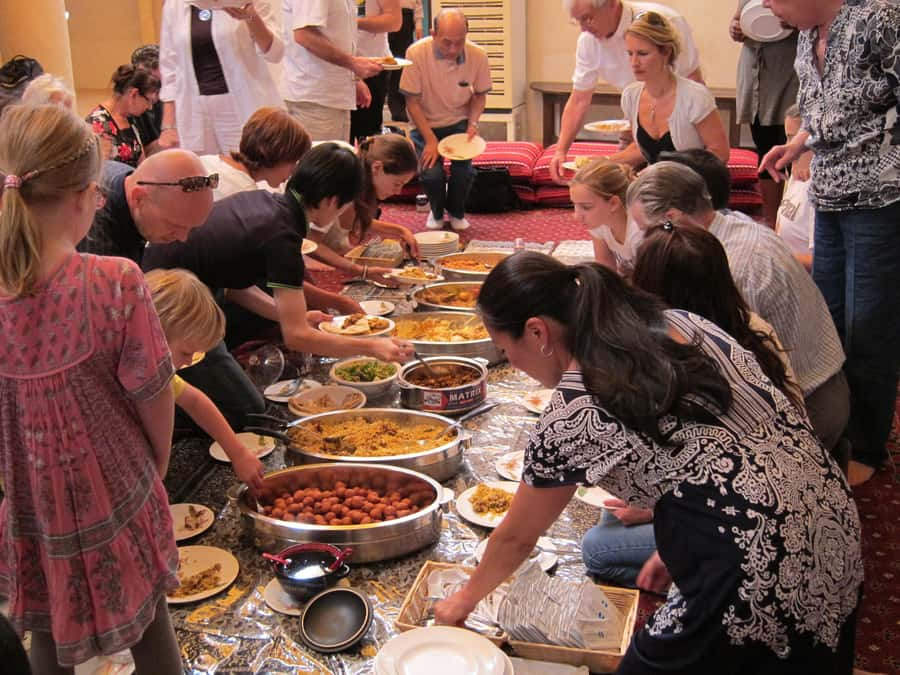
You receive a selection of local Emirati dishes, along with dessert. The exact menu is not fixed in the information provided, so I would not book this expecting one particular recipe or a set tasting list.
That flexibility has two sides. It keeps the meal connected to what the center is serving that day, but it also means the food may not match every person’s idea of a traditional Arabic meal. One past diner found the dishes more Indian than expected. That is worth knowing if your main reason for booking is a precise culinary survey of Emirati cuisine.
Still, the meal is an important part of the experience. Food gives you something concrete to discuss. You can ask about ingredients, home cooking, hospitality, and when certain dishes are served. Several past accounts praised the taste and quality, while others especially valued being able to take leftovers away. Takeaway containers and plastic bags have been available on some occasions, though you should not assume this will always be offered.
I like the fact that the food is not treated as decoration. You eat a proper selection of local dishes while learning about the culture that produced them. At the same time, I would describe this as a cultural lunch with food, not as a specialist cooking class or a full food tour.
Dessert is included, but no specific dessert is guaranteed. If you have dietary restrictions, the supplied information does not explain how they are handled, so ask the center before booking rather than assuming substitutions are available.
Same base, a different sort of day:
- Dubai: Safari, Quad Bike, Camel Ride, and Buffet Dinner
★ 4.9 · 33,424 reviews - Dubai: Red Dune Safari, Quad Bike, Camel Ride, BBQ Dinner
★ 4.9 · 32,185 reviews - Dubai: Premium Safari, Camel Ride & Al Khayma Camp 3-Buffets
★ 4.9 · 30,335 reviews - Dubai: Burj Khalifa Sky Level 148, 124, & 125 Entry Ticket
★ 4.6 · 23,827 reviews
The questions are the main event
The center’s guiding idea is Open Doors, Open Mind. In practical terms, that means you are invited to ask what you really want to know.
The strongest part of the program is likely to be the exchange with your host. You can ask about Islam’s influence on local values, Emirati traditions, greetings, expressions, clothing, religion, and subjects that may feel awkward to raise in an ordinary social setting. The center’s purpose is to make those conversations easier and more respectful.
I would arrive with a few questions ready. Ask how hospitality works, what a visitor should know about greetings, or how religious values shape daily life. You can also ask about customs that affect a short visit, such as sensitivities around behavior or social interaction. The host will guide the discussion, but the experience becomes more useful when you take part.
The format is not a one-way talk. Past sessions have been led by people described as friendly, open, entertaining, and well informed. Nasser was praised for humor, while Ruqaya was noted for her clear explanation of Emirati culture. Khaled received strong approval for answering questions and encouraging discussion. These individual hosts show the value of the center’s approach, though the exact style will vary with the person leading your lunch.
You should not expect every cultural question to receive a short, simple answer. That is part of the value. Customs can have religious, social, and historical reasons at the same time. A good conversation may leave you with more questions, which is a useful result if you want to understand Dubai beyond its main sights.
How much time to allow around the 1.5-hour lunch
The scheduled experience lasts 1.5 hours. That is long enough for coffee, dates, the meal, dessert, and a meaningful question period, but short enough to fit with an afternoon in Al Fahidi.
I would pair it with time in the Al Fahidi Historic District rather than rushing in from the other side of Dubai. The lunch itself does not include a wider walking tour, so plan separately if you want to explore the surrounding lanes and buildings.
The short duration is helpful for families, first-time visitors, and anyone with a busy schedule. It also keeps the event focused. You will not spend half a day waiting for a meal or sitting through a long formal presentation.
On the other hand, one and a half hours can pass quickly when conversation gets going. If you want an extensive discussion of Emirati history, Islamic practice, or local cuisine, this will be an introduction rather than the final word. I would treat it as a starting point for seeing Dubai with more awareness.
The host speaks English, and the listed language is English. That makes the program especially useful if you want to ask detailed questions without a language barrier.
Is $42 a fair price?
At $42 per person, this costs more than an ordinary local lunch, but the comparison is not quite fair. You are paying for a meal, Arabic coffee, tea, dates, dessert, a traditional setting, and 1.5 hours of guided cultural conversation.
If you only want to eat, you can find cheaper options. If you want a polished cooking lesson or a large range of Emirati dishes, this may not be the best match. The menu varies, and the food is only one part of what you are buying.
I think the price is reasonable for a first introduction to local culture, especially at the beginning of a Dubai visit. The value comes from the setting and the questions. A regular meal may fill you up, but it will not necessarily explain why certain customs matter or give you a comfortable place to ask about Islam and Emirati life.
The experience also offers free cancellation up to 24 hours before the start time and allows you to reserve now and pay later. Those terms make it easier to fit into a changing Dubai schedule. Starting times depend on availability, so check the current option when booking.
Who will get the most from this experience?
This lunch suits you if you want direct cultural context and prefer conversation to a formal sightseeing tour. It is a strong choice for first-time visitors who want a better introduction to the UAE before spending the rest of the trip on major attractions.
It also fits solo visitors and couples well, since the open question format gives you a reason to talk with the host and the people sharing the meal. Families may appreciate the short length, though young children who dislike floor cushions or discussion-heavy activities may not get as much from it.
The program is less suited to you if your priority is a detailed food itinerary. The dishes are traditional in intent, but the exact menu can change, and at least one past meal leaned more toward Indian flavors than expected. I would also choose another activity if you want a long architectural tour, since the wind tower house is part of the setting rather than a separate guided visit.
Should you book the SMCCU cultural lunch?
Book it if you want to understand Dubai through its people, customs, and religious context, not only through its buildings. The strongest reasons are the historic house, the open questions, and the chance to enjoy local food without a stiff lecture.
Go with realistic expectations. This is a 1.5-hour introduction, not a complete guide to Emirati society, and the menu may vary. Allow extra time to find House 26, especially if construction has changed the paths around Al Fahidi.
For $42, I consider it a worthwhile first cultural activity in Dubai. You get a meal and a setting, but the real value is the permission to ask honest questions in a respectful place. If that sounds more useful to you than another standard sightseeing stop, book it.
FAQ
Where does the cultural lunch take place?
It takes place at the Sheikh Mohammed Center for Cultural Understanding, House 26 on Al Musallah Road in the Al Fahidi Historic District, adjacent to the Ruler’s Court.
How long does the experience last?
The cultural lunch lasts 1.5 hours.
What food and drinks are included?
You receive a selection of local Emirati dishes, dessert, Arabic coffee, tea, and dates.
Is the lunch served in a traditional building?
Yes. The center is located in a traditional wind tower house in the Al Bastakiya trading village of the Al Fahidi Historic District.
What language does the host speak?
The host or hostess conducts the experience in English.
Can I ask questions about Islam and Emirati customs?
Yes. The program encourages questions about Arabic culture, greetings, expressions, local customs, traditions, and the influence of Islam on local values and sensitivities.
Is the activity wheelchair accessible?
The activity is listed as wheelchair accessible.
How much does the experience cost?
The listed price is $42 per person.
Can I cancel if my plans change?
You can cancel up to 24 hours in advance for a full refund. You can also reserve now and pay later.
Just added in Dubai
- Dubai Walking Tour★ 5.0 · 7 reviews
- Dubai Unique Sunset Combo: 4WD and Quad Bike Red Dunes Safari★ 5.0 · 54 reviews
- Dubai Wild Wadi Water Park Admission Ticket★ 4.5 · 9 reviews
- Dubai Secret Food Tours with Access to Burj Khalifa bar★ 5.0 · 49 reviews
- Dubai Walking Tour “Fahidi Area, Dubai Museum, Souks”★ 5.0 · 13 reviews
- Dubai: Unique SUNSET Buggy Red Dunes Safari★ 5.0 · 32 reviews
- Half-Day Private City Tour with Magical Dubai Frame Visit★ 4.5 · 9 reviews
- Dubai: Unique SUNRISE 4WD Red Dunes Safari★ 5.0 · 68 reviews
Tours in Dubai, compared.

Burj Khalifa Levels 124 & 125 Entry Ticket + Options
Read our review →
Desert Safari, Quad Bike, Camel Ride & Al Khayma Camp
Read our review →
Desert Safari, Quad Bike, Camel Ride and Sandboarding
Read our review →
Safari, Quad Bike, Camel Ride, and Buffet Dinner
Read our review →
Red Dune Safari, Quad Bike, Camel Ride, BBQ Dinner
Read our review →
Premium Safari, Camel Ride & Al Khayma Camp 3-Buffets
Read our review →
Burj Khalifa Sky Level 148, 124, & 125 Entry Ticket
Read our review →
The View At The Palm Observatory Entry Ticket
Read our review →Browse the lists this tour appears in